Most businesses now choose a logo from three realistically different paths: a freelance designer, a professional design agency, or an AI logo tool. Each one can produce a usable mark, but they’re not interchangeable. A freelancer, an agency, and an AI generator solve different problems, at different price points, with different risks attached to ownership and long-term scalability.
The right choice usually comes down to a handful of factors:
- Your budget
- How far along your brand strategy already is
- How complex the identity needs to be — one mark, or a full system across digital, print and packaging
- Your timeline
- How long you expect this identity to last before a redesign
- Whether you need formal brand guidelines
- How much certainty you need around ownership and trademark usage
Get those straight first, and the freelancer-vs-agency-vs-AI question mostly answers itself.
Which Logo Design Option Is Best?
There isn’t a single best option — there’s a best option for your situation. As a starting point:
- Choose an AI tool if you need something today, your business idea may still change, and the mark is genuinely temporary.
- Choose a freelancer if you have a straightforward brief, a modest budget, and are comfortable managing revisions yourself.
- Choose an agency if the logo has to work as part of a larger brand system — across a website, packaging, signage, investor decks, and multiple future campaigns — and getting it wrong would be expensive to undo.
Here’s how the three options actually compare, factor by factor:
| Factor | Freelancer | Agency | AI Tool |
|---|---|---|---|
| Cost | Low to moderate | Moderate to high | Very low to low |
| Speed | Days to two weeks | Several weeks | Minutes |
| Brand strategy | Varies by individual | Structured, research-led | Minimal to none |
| Originality | Medium to high | High | Low to medium (template/pattern-based) |
| Customization | High, if briefed well | High | Limited by the tool’s templates |
| Research (audience, competitors) | Sometimes, depends on the designer | Usually built into the process | Not performed |
| Revisions | Typically 2–3 rounds | Multiple structured rounds | Unlimited self-serve regeneration |
| Scalability across touchpoints | Depends on deliverables agreed upfront | Usually planned for | Weak — logos can look generic or clash at scale |
| Brand guidelines | Rarely included | Often included or available | Not provided |
| Human expertise | Yes, one person’s | Yes, a team’s | No |
| Ownership considerations | Contractual, generally clear | Contractual, generally clear | Varies by tool’s terms — verify before relying on it |
| Best for | Budget-conscious, well-defined projects | Brands that need a full identity system | Early validation, placeholders, fast experiments |
This table is descriptive, not a scorecard — the “best for” row is really doing the work here.
When Should You Hire a Freelancer for a Logo?
A freelancer is often the right middle ground: a real person, without agency overhead. The catch is that quality and process vary a lot from one freelancer to the next, so it pays to know what you’re looking for.
A freelancer tends to work well when:
- You already have a clear enough sense of your brand to write a good brief
- Your project is one logo, not a full identity system
- Your budget sits below agency territory, but you still want a human designer rather than a template
- You’re comfortable being the project manager — chasing revisions, checking file formats, keeping the timeline moving
A few things worth checking before you commit:
- Look at their portfolio for originality, not just polish — a portfolio full of similar-looking marks usually means a template habit, not a process
- Confirm upfront how many concepts and revision rounds are included
- Ask exactly what files you’ll receive — a logo without editable vector source files becomes a real headache the first time you need to resize it for a banner or a packaging die-line
- Get ownership stated in writing, not assumed
In short: a freelancer suits a business with a well-defined brief, a single-logo scope, and the bandwidth to manage the process directly.
When Should You Hire a Logo Design Agency?
An agency’s higher price generally buys a structured process, not just “more design.” A properly run agency project typically includes:
- Competitor and audience research before any visuals are drawn
- Strategic positioning work, so the mark is built on reasoning rather than guesswork
- Multiple specialists — a strategist, a typographer, a designer — rather than one generalist wearing every hat
- A finished system, not just a mark: rules for how it scales across a website, social profiles, packaging, signage, and print
Jootoor’s own process, for example, moves through discovery and research, strategy development, concept creation, presentation and feedback, refinement, and finally delivery of a complete file and brand-support package. It’s built so that discovery and competitor research happen before any final direction gets locked in, rather than after.
A few examples of that process in practice, from our own portfolio:

Saffron Resources Private Limited

Ciela Spa Logo Design

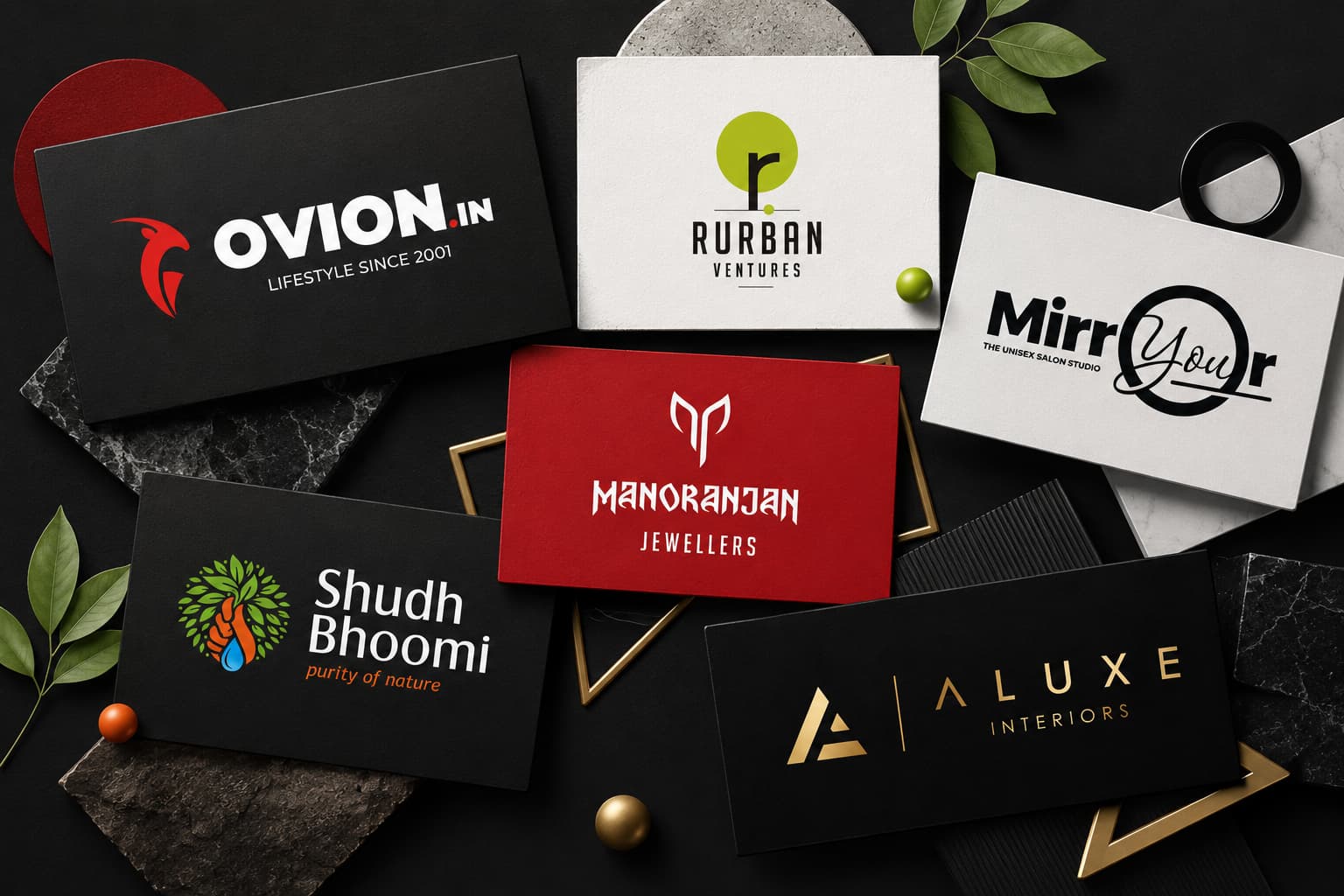
RurBan Logo Design

Mirror You Logo Design
That structure is what justifies the higher cost, when it’s justified at all. It isn’t automatically worth it for every business — a pre-revenue idea that might pivot in three months doesn’t need a six-week identity system. It earns its cost when the logo carries real downstream risk if it’s wrong: multiple touchpoints to keep consistent, an audience that notices inconsistency, or a growth trajectory where a redesign eighteen months in would be expensive and disruptive.
In short: an agency makes sense when the logo is one piece of a larger brand identity that needs to hold up across many channels, over years, without a redesign.
When Does an AI Logo Tool Make Sense?
AI logo tools deserve a fair hearing rather than a reflexive dismissal. They’re genuinely useful for a few specific, narrower jobs:
- Early idea exploration and moodboarding, before you’ve committed to a direction
- A temporary placeholder logo for a landing page while you validate whether the business idea itself works
- Very tight or zero budgets in the pre-revenue stage
- Fast experimentation across many visual directions in one sitting — something no human process can match for sheer volume of options per minute
Where they tend to fall short:
- Outputs are built from templates and training data, so AI-generated marks can look generic or land close to something already in use — a real risk if you later want to defend the mark as distinctive
- There’s no strategic understanding of your specific audience or competitive position behind the output — the tool doesn’t know your customers, only patterns in its training data
- Typography and spacing control tend to be shallow compared with what a trained eye adjusts by hand
- Consistency across future applications (packaging, signage, a favicon that still reads at 16 pixels) is rarely considered by the tool
- Ownership is genuinely more complicated — worth understanding the copyright and trademark risks of AI logos before you build a business around one, since copyright, trademark, and a tool’s own commercial-use license are three separate things that don’t automatically move together
Terms change between tools and over time, so verify the specific tool’s current policy, and for anything business-critical, get that verification from a qualified legal professional rather than a blog post — including this one.
For a closer look at DIY and AI options, including where AI works best as a brainstorming step before a human refines the output, that comparison goes a level deeper into each path.
In short: AI tools are best treated as a validation-stage or exploration tool, not a brand identity meant to last.
Freelancer vs Agency vs AI Logo Tool: Detailed Comparison
Zooming in on the dimensions that actually change the outcome:
- Cost. AI tools are free to a few thousand rupees a month in subscription fees. Freelancers in India commonly range from roughly ₹1,000 for beginner work to ₹20,000+ for an experienced specialist. Agencies typically start around ₹25,000 and scale well past ₹1,50,000 for a full identity system.
- Quality and creativity. Freelancer quality varies with the individual; a strong freelancer with a relevant portfolio can rival agency creative work on a single mark. Agencies bring a team and a structured critique process, which tends to produce more consistently strategic results across a full system. AI tools produce polished-looking but pattern-derived output — competent, rarely distinctive.
- Speed. AI: minutes. Freelancers: typically a few days to two weeks. Agencies: several weeks, because research and strategy come before any concept work.
- Research. This is the sharpest dividing line. Agencies build competitor and audience research into the process by default. Freelancers do so if you ask for it and pay for the time. AI tools don’t perform research at all — they pattern-match.
- Revisions and communication. Freelancers usually offer two to three revision rounds with direct one-to-one communication. Agencies run structured revision cycles with more formal presentation. AI tools let you regenerate endlessly yourself, which feels flexible but shifts the curation work entirely onto you.
- File formats and deliverables. All three can theoretically deliver vector files, but only freelancers and agencies reliably do so without an upsell — many AI tools gate SVG or source-file exports behind a higher tier.
- Ownership and long-term support. Freelancer and agency contracts typically make ownership explicit. AI tool ownership depends entirely on that platform’s terms at the time you used it. Long-term support — a font tweak, a color update two years later — is realistic with a freelancer you can recontact or an agency relationship, and essentially nonexistent with a one-time AI export.
What Each Option Actually Costs in India
Pricing varies with research depth, number of concepts, revision rounds, and what’s included beyond the logo itself — brand guidelines, social assets, multiple file formats. As a general India-market range:
| Option | Typical Range (INR) |
|---|---|
| AI logo tool | Free – ₹3,000/month (subscription tools) |
| Beginner freelancer | ₹1,000 – ₹5,000 |
| Experienced freelancer | ₹5,000 – ₹20,000 |
| Small design studio | ₹15,000 – ₹50,000 |
| Professional branding agency | ₹25,000 – ₹1,50,000+ |
The cheapest option here isn’t automatically the best value, and the most expensive isn’t automatically overkill — value depends on how long the identity needs to last and how many places it needs to work consistently. For the full breakdown of what drives pricing within each tier, including city-by-city differences, see the logo design cost breakdown, which walks through seven real-world pricing scenarios in depth.
7 Questions to Ask Before Hiring a Logo Designer
Whether you’re vetting a freelancer or an agency, these questions tend to surface the gaps that matter most before you sign anything:
- How do you research my industry and competitors before designing? A real answer describes a process; a vague answer suggests the design will be more decorative than strategic.
- How many concepts are included, and how were they chosen? More concepts aren’t automatically better — ask how each direction ties back to your positioning.
- How many revision rounds are included, and what happens beyond that? Get this in writing so scope doesn’t quietly expand.
- Will I receive editable, vector source files (not just a PNG)? This one question prevents most future “we can’t resize our own logo” problems.
- Who owns the final design, and is that stated in writing? Don’t assume — confirm.
- Will the identity scale across digital and print, at small sizes and large ones? Ask to see it mocked up small (a favicon) and large (signage), not just on a presentation slide.
- Do you provide brand guidelines, and what do they cover? Even a simple one-page guideline — colors, spacing, minimum size, don’ts — prevents inconsistent use down the line.
For more on choosing a logo design company specifically, that’s covered in more detail separately.
Freelancer, Agency, or AI? Use This Decision Framework
- Pick AI when you need speed, low-stakes experimentation, or a temporary visual starting point — and you’re honest with yourself that it’s temporary.
- Pick a freelancer when you need affordable, custom design for a relatively contained project, you can write a clear brief, and you’re prepared to manage the process yourself.
- Pick an agency when your logo is part of a broader brand strategy, the identity needs to work consistently across multiple customer touchpoints, and getting it wrong (a redesign, inconsistent assets, diluted recognition) would cost more than doing it properly once.
The Real Cost of Choosing the Wrong Option
The sticker price of a logo isn’t the total cost of a logo decision. A cheap or generic mark can quietly generate downstream costs:
- A full rebrand once the business outgrows it
- Inconsistent assets across platforms because the original file set was incomplete
- Weak scalability that forces a redesign the first time the logo needs to go on packaging or signage
- Diluted positioning if the mark looks too close to competitors’ — a real risk with template-derived output
None of this means every cheap logo fails or every expensive one succeeds. It means the real comparison isn’t “₹2,000 vs ₹50,000” — it’s “₹2,000 now vs ₹2,000 now plus a possible ₹40,000 redesign in eighteen months.” It’s also worth remembering that a logo isn’t the same as your full brand identity — a mark can be technically fine and still fail to carry the broader positioning, tone, and consistency a growing business needs, which is exactly the gap agencies are built to close.
Final Verdict
There’s no universally correct answer among a freelancer, an agency, and an AI tool. AI tools earn their place for fast, low-stakes exploration. Freelancers can deliver genuinely strong, affordable work on a well-scoped project. Agencies earn their higher cost when a logo has to function as part of a larger, longer-lived brand system — which matters even more at the fundraising stage, where startup branding signals investors notice can shape first impressions before a single slide is discussed.
Whichever path fits your business, the framework above should make the decision itself a lot clearer.
Need Help Deciding, Or Ready For A Custom Logo?
Jootoor Designs builds logos around strategy, research and creative development — not templates.
Frequently Asked Questions
It depends on scope. A freelancer suits a single, well-defined logo project on a moderate budget. An agency suits a logo that’s part of a larger, longer-lived brand system spanning multiple touchpoints.
For early validation, moodboarding, or a temporary placeholder, yes. For a logo meant to represent a growing business long-term, an AI tool alone usually falls short on originality, strategic fit, and ownership certainty.
Roughly ₹1,000 for beginner work up to ₹20,000+ for an experienced specialist, depending on research depth, concepts, and revisions included.
Typically ₹25,000 to ₹1,50,000 or more, depending on the scope of the identity system and deliverables beyond the mark itself.
Not reliably. They’re built from templates and training-data patterns, which is why AI outputs can resemble existing marks — a real consideration if distinctiveness matters to your brand.
Sometimes, but it’s more complicated than with a human-designed mark, and depends on the specific tool’s terms, how much human refinement was added, and current trademark office practice. See our guide to logo trademark protection in India for the fuller picture, and verify anything business-critical with a qualified professional.
A freelancer is one person handling the whole project; an agency is a team with a structured, research-led process. Agencies generally offer more consistency and strategic depth; freelancers generally offer lower cost and more direct communication.
When the logo needs to carry real business weight — investor perception, multi-channel consistency, or long-term brand recognition — rather than serving as a short-term placeholder.
It depends on the stage. Pre-validation, AI or a freelancer is reasonable. Once you’re building toward investor conversations or long-term positioning, a more structured process starts to pay for itself.
A clear research process, transparent concept and revision counts, editable vector file delivery, explicit ownership terms, and evidence the identity has been tested at both small and large scale.